How to Create a 3D AR Model From an Image: AI Tools & Step-by-Step Guide
Turn photos into production-ready 3D AR models in minutes, with Augmento and the new generation of AI 3D tools (Meshy, Tripo3D, Hunyuan3D).
Turning a 2D image into an immersive 3D AR experience used to mean specialized software, a 3D artist, and a long pipeline. With Augmento Studio and the new generation of AI 3D generation tools, it now takes about two minutes, runs in your browser, and produces export-grade GLB files. This guide walks through the whole flow, end to end, plus the AI tools that have quietly reshaped the workflow.
"Everything you can imagine is real." Pablo Picasso
Why Convert Images to 3D AR Models?
Higher engagement. 3D models hold attention significantly longer than static images, and the data is consistent across art, retail, and education.
Versatility. The same model works in marketing, e-commerce, gallery installations, and AR-on-glass experiences.
Accessibility. No specialized hardware or software is required, the experience runs in any modern browser.
Memorability. Audiences remember experiences they can walk around, not ones they scroll past.
The Modern AI 3D Generation Stack
The reason this is suddenly easy is that AI 3D generation went from research demos to shipping product in roughly 18 months. A handful of tools now turn a single photo (or even a text prompt) into a textured, watertight 3D mesh you can drop into a website, a game engine, or AR.
The three names worth knowing right now:
Meshy.ai, fastest path from image or prompt to 3D
Meshy.ai is the most polished consumer-grade option. Drop in an image, or just type a prompt, and Meshy returns a textured 3D model with PBR materials in roughly a minute. It supports image-to-3D, text-to-3D, AI texturing for existing meshes, and animation rigging, all in one workspace. Outputs are clean enough that we use them as starting points for AR experiences without much manual cleanup.
Tripo3D, high-quality meshes with strong topology
Tripo3D is the option we reach for when we care about clean geometry, especially for hard-surface objects (products, vehicles, architectural elements). The mesh comes out with sensible quad-leaning topology and crisp edges, which makes downstream texturing and animation much less painful. It also exposes a generous API for teams who want image-to-3D as a backend service rather than a UI.
Hunyuan3D, Tencent's open AI 3D model
Hunyuan3D (now in its 2.0 generation) is Tencent's open-source image-to-3D model, and it changed the game for self-hosted pipelines. Quality is competitive with the closed tools, and because the weights are open, you can fine-tune on a domain (sneakers, sculpture, furniture) and run inference locally for privacy-sensitive workflows. If you're building product features that depend on AI 3D generation at scale, Hunyuan3D is the model to evaluate first.
Step-by-Step Guide to Creating a 3D AR Model
Choose your image. Select a high-quality file, JPG, PNG or WebP all work. Sharp, well-lit images produce the cleanest 3D models. AI tools especially benefit from a clear silhouette and even lighting.
Generate the base mesh. Either upload to Augmento Studio for our framing-focused workflow, or use an AI generator like Meshy.ai for a full 3D mesh from the photo. For object scans where topology matters, try Tripo3D.
Customize your model. Pick the presentation that fits your use case:
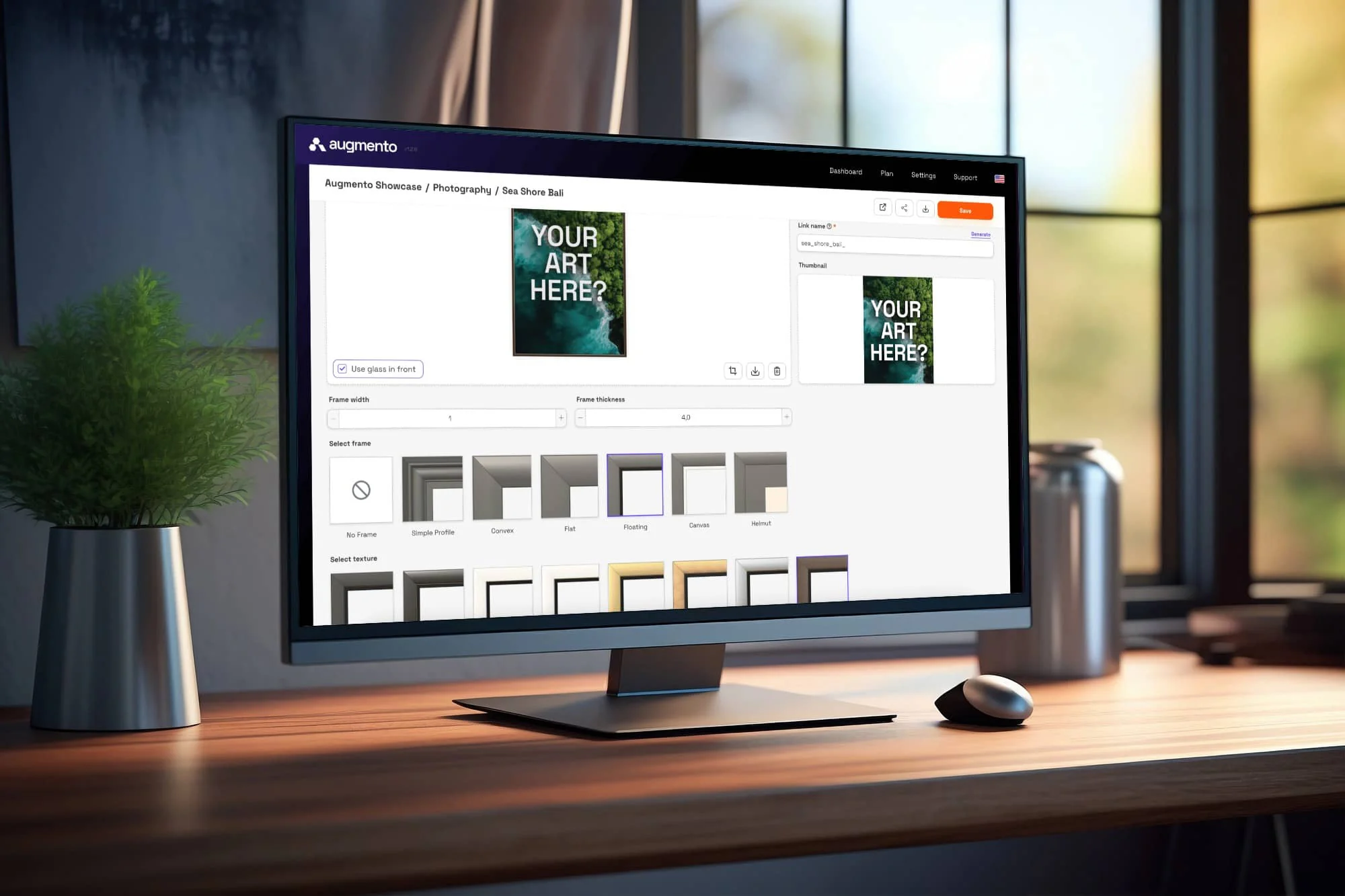
Add a glass front for a polished, gallery-style look
Insert a paper frame or matte board for a printed-edition feel
Choose from dozens of frame styles, from minimalist to ornate
Refine textures and materials. If you generated with an AI tool, the PBR textures are usually good but not perfect. Augmento lets you tweak colour, gloss and emissive maps before exporting.
Generate your 3D model. Augmento's pipeline turns the image into a textured 3D asset and prepares it for AR viewing.
Preview and adjust. Rotate, scale and re-frame the model. If something looks off, tweak the source image or the frame and regenerate.
Download your GLB file. Export the standard GLB asset, ready to drop into AR applications, websites, or our own viewer.
"The aim of art is to represent not the outward appearance of things, but their inward significance." Aristotle
With Augmento, you're not just preserving the outward appearance of an image, you're giving it new depth and significance in the digital realm. For a deeper look at the underlying tech, see our piece on 3D scanning with Gaussian splatting.
How to Choose Between These Tools
None of these are mutually exclusive, in fact, the best workflow usually combines two or three. Here's the rule of thumb we use internally:
Single hero asset, fastest possible turnaround. Meshy.ai for the mesh, Augmento Studio for the AR framing and export.
Production catalog where topology matters. Tripo3D for the base meshes, then a manual pass for retopology, then Augmento for the AR layer.
Self-hosted, fine-tuned, or privacy-sensitive. Hunyuan3D running on your own GPU, plus Augmento at the end of the pipeline for distribution.
Image into framed AR artwork. Augmento Studio end-to-end, no AI mesh generation needed.
Where AI 3D Generation Is Heading
Three trends are accelerating fast. Worth paying attention to if you're building anything in this space:
Multi-view diffusion. Newer generators infer multiple synthetic camera angles before fusing them into a 3D mesh, which dramatically improves geometry on the back of objects, the long-standing weakness of single-image 3D generation.
PBR-native outputs. Earlier tools produced baked colour textures. Today's leading tools (Meshy, Tripo3D and Hunyuan3D) emit albedo, roughness, metallic and normal maps directly, which makes the assets engine-ready without a manual texture pass.
Text-to-3D quality finally crossing the bar. A year ago, text-to-3D was a curiosity. Today, the same tools that excel at image-to-3D produce useful prompt-based assets, opening up workflows where you don't even need a reference photo.
For a broader look at how AI is reshaping the AR layer (not just generation, but personalization and interaction), our CES 2025 recap covers the wider trend.
Benefits of Using Augmento
Web-based, no software installation required
User-friendly, built so non-technical users can ship in minutes
Versatile, works with most common image formats and AI-generated meshes
Customizable, multiple framing options for the right presentation
High-quality output, export-grade GLB files
Where to Use Your New 3D AR Model
E-commerce listings, let buyers view the product from every angle in their own space
Galleries and exhibitions, extend a physical show into anyone's living room
Marketing campaigns, see how this fits into broader AR-driven marketing strategies
Education, give students an artifact they can pick up and rotate
Conclusion
Creating a 3D AR model from a single image used to be a specialist's job. Now, between AI 3D generation tools like Meshy.ai, Tripo3D and Hunyuan3D, and a polished AR pipeline like Augmento, it's a five-minute task anyone can do.
If you're an artist, marketer or builder ready to step into the future of digital media, try Augmento Studio, and watch your images leap off the screen.